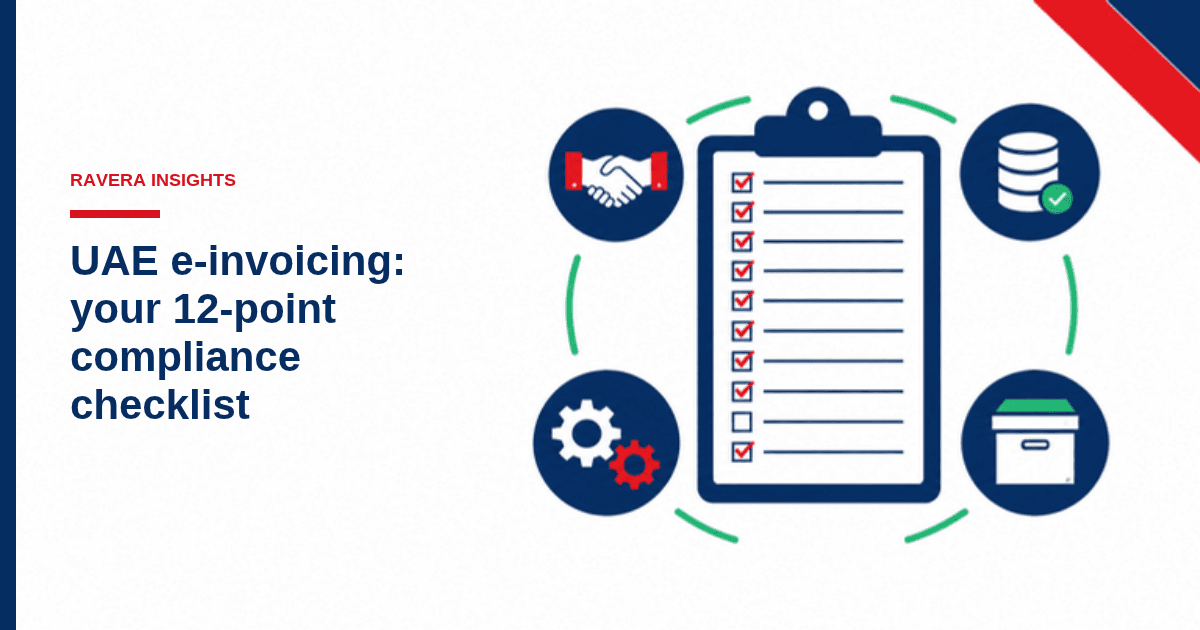
UAE e-invoicing compliance comes down to four things: the right partner, the right data, the right process and the right records. Use this checklist to check where you stand.
Partner
- Confirm you're in scope. Any business operating in the UAE with B2B or B2G transactions, unless the transaction is excluded under Ministerial Decision 197 of 2026.
- Know your deadline. Revenue ≥ AED 50m: live by 1 Jan 2027. Under AED 50m: ASP by 31 Mar 2027, live by 1 Jul 2027.
- Appoint an ASP from the MoF list. See how to choose an ASP.
- Get your Peppol ID registered (0235 + your 10-digit TIN).
Data
- Map every mandatory field. The MoF's mandatory field requirements (v1.1) list what each invoice must carry: invoice type code, transaction-type flags, seller and buyer identifiers, TRNs, tax breakdown and line details. See PINT AE explained.
- Clean customer master data. Buyer TRNs, legal registration numbers and Peppol IDs must be correct, or invoices will be rejected.
- Identify your special cases: free zone supplies, deemed supplies, margin scheme, continuous supplies, exports, disclosed agents, self-billing.
Process
- Connect your ERP to your ASP's API, built by your ERP team or integrator, then test with real invoices.
- Issue within 14 business days of each transaction, including credit notes.
- Handle rejections. Assign someone to fix and resend invoices that fail validation.
- Set up inbound reception so supplier e-invoices reach your AP team.
Records
- Archive for the legal period: 5 years after the tax period for most records, 7 for real estate, plus 4 if there is an audit or dispute.
The cost of skipping a step
Not implementing: AED 5,000 plus AED 5,000 a month, capped at AED 50,000 a year. Each missed invoice or credit note: AED 100, up to AED 5,000 a month. See the penalties guide.
Not sure where you stand? Take the readiness check, or ask Ravera for test access to check your ERP connection.