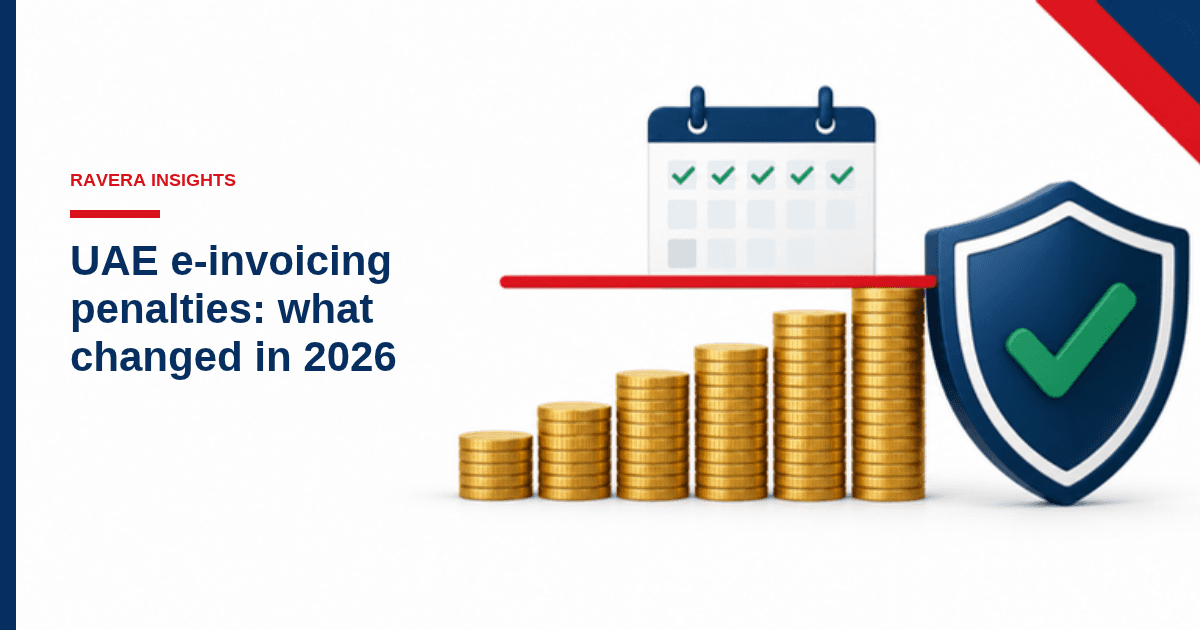
The UAE's e-invoicing penalties changed in 2026. Cabinet Decision No. 173 of 2026 repealed the original Cabinet Decision No. 106 of 2025. The headline: an annual cap on the biggest fine, a smaller daily fine, and two penalties removed.
The penalties at a glance
| Violation | Before (Cabinet 106/2025) | Now (Cabinet 173/2026) |
|---|---|---|
| Not implementing the system, including not appointing an ASP | AED 5,000 per month of delay, no cap | AED 5,000, plus AED 5,000 per month while it continues; capped at AED 50,000 in any 12 months |
| Not issuing or transmitting an e-invoice | AED 100 per invoice, max AED 5,000 a month | Unchanged |
| Not issuing or transmitting an e-credit note | AED 100 per note, max AED 5,000 a month | Unchanged |
| Not notifying the FTA of a system failure | AED 1,000 per day | Removed |
| Not notifying your ASP of changes to registered data | AED 1,000 per day | AED 250 per day, max AED 5,000 a month |
Was the daily penalty removed?
Partly. The AED 1,000-a-day penalty for not reporting a system failure is gone; Ministerial Decision 197 of 2026 also deleted System Failure from the definitions. One daily penalty remains: AED 250 a day for not telling your ASP about changes to your registered data, now capped at AED 5,000 a month.
When do penalties start?
Only from the date you are required to implement. Per the MoF guidelines:
- Revenue of AED 50 million or more: from 1 January 2027.
- Revenue under AED 50 million: from 1 July 2027.
- Government entities: from 1 October 2027.
Voluntary early adopters are not penalised for invoices they send voluntarily. See the full deadlines tracker.
What the cap means in practice
Under Cabinet Decision 173 of 2026, the fine for not implementing the system starts at AED 5,000 and adds AED 5,000 for each month, or part of a month, that the failure continues. It stops rising at AED 50,000 in any 12 consecutive months. A business with revenue of AED 50 million or more that is still not live on 1 January 2027 would reach the cap after roughly nine months of non-compliance.
Invoice-level fines are capped separately. A business that fails to issue 60 e-invoices in one month would face AED 6,000 at AED 100 per invoice, but the monthly cap limits it to AED 5,000. The same AED 5,000 monthly cap applies to missed e-credit notes and, at AED 250 a day, to unreported changes in your registered data.
Three things that reduce your exposure
- Appoint an ASP now. The not-implementing penalty is the largest and builds monthly until it hits the cap.
- Automate issuance. Missed invoices cost AED 100 each, and you have 14 business days from the transaction to issue.
- Keep your ASP data current. A change of address, TRN or legal details left unreported costs AED 250 a day.
Work through the full requirements checklist to close the gaps.
One violation, one penalty
If you are both issuer and recipient on the same transaction, Cabinet Decision 173 applies only one penalty for the same violation.
Penalties FAQ
Do penalties apply if we start e-invoicing early?
No. Businesses that go live voluntarily are not penalised for voluntary e-invoices. Penalties apply only from your mandatory go-live date.
Is there a maximum penalty?
Yes. The fine for not implementing the system is capped at AED 50,000 in any 12 consecutive months. Fines for missed e-invoices, missed e-credit notes and unreported data changes are each capped at AED 5,000 a month.
If we are both issuer and recipient, are we fined twice?
No. Cabinet Decision 173 applies only one penalty for the same violation.
When do penalties start for businesses under AED 50 million?
From 1 July 2027, their mandatory go-live date. Government entities follow from 1 October 2027.
Avoid penalties before the deadline. Ravera is an FTA-Accredited Service Provider, owns its Peppol access point, and helps your team test its ERP connection before go-live. Book a call.